Amrit Dhami’s story
My great-grandfather, Subedar Major Narayan Singh Dhami, son of Dhian Singh, from the village of Nurpur, Hoshiarpur District, Punjab, served in the British Indian Army during the First World War.
My nine-year-old nephew was doing a school project on the world wars, which inspired our family to research our great-grandfather’s military service and uncover a part of our history that has remained largely unknown.
We have very little information about where he served or the details of his military career. My late father shared stories about him when I was growing up and believed he had served in Italy, although we have yet to establish whether this was the case.
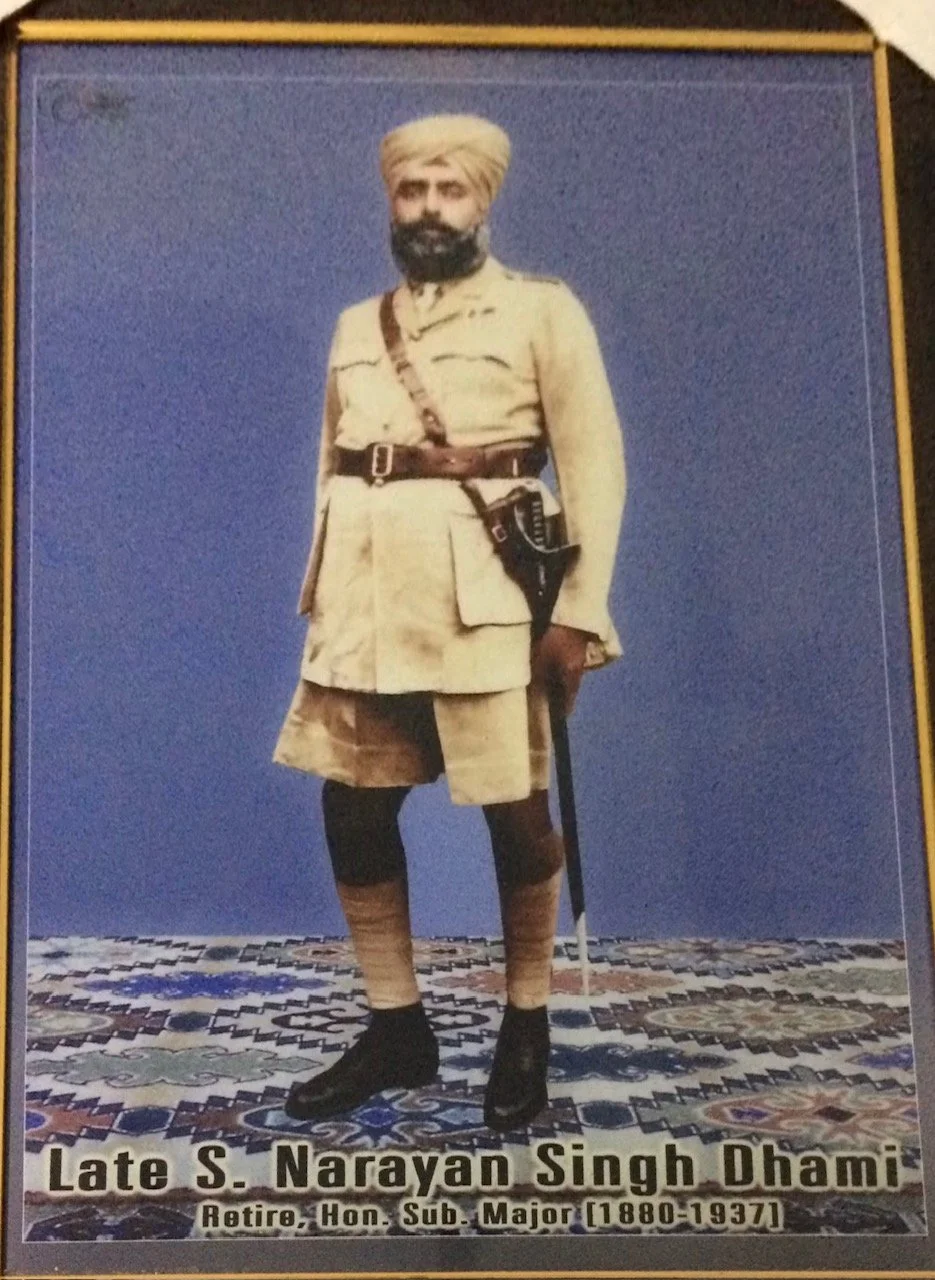
We have a photograph of him proudly posing in his British Indian Army uniform, which offers fascinating clues about his service.
His distinctive shoulder straps with horizontal braiding identify him as a Subedar, a highly respected Indian commissioned officer who commanded troops and acted as an important link between Indian soldiers and British senior officers.
He wears the iconic leather Sam Browne belt, supporting an officer’s dress sword, with a whistle lanyard beneath his collar and what appear to be service medal ribbons above his left pocket. His khaki uniform, shorts, woollen puttees and military boots offer further insight into the clothing worn by soldiers serving in challenging overseas environments.
Although we cannot yet confirm his exact theatre of service, we are keen to establish whether he served in Italy, the Middle East or elsewhere during the war.
A legacy beyond military service
For our family, Narayan Singh’s story is about much more than his military rank or service. Although he died relatively young in 1937, he left a lasting legacy. In 1927, he built our ancestral home in Nurpur, which still stands proudly today, almost a century later.
His hard work and sacrifices helped create opportunities for generations of our family. His sons were able to travel to Glasgow in search of a better life, while his grandchildren went on to pursue higher education and opportunities that may otherwise have been beyond their reach.
Those values of resilience, ambition and service continue through our family today. One particularly meaningful example is my cousin, Sukhman Dhami, a human rights lawyer based in New York and founder of Ensaaf, an organisation dedicated to seeking justice and accountability for human rights violations in Punjab.
To me, this reflects a legacy that goes beyond personal achievements or recognition. It represents standing up for justice, supporting others and making a positive difference in society.
What his story means to me
Discovering more about my great-grandfather fills me with immense pride and gratitude. It reminds me that the opportunities we enjoy today are built on the sacrifices of those who came before us. From building our ancestral home in Nurpur to creating opportunities for future generations, his legacy lives on through our family and the values of resilience, ambition, unity and selfless service.
Despite the colonisation and eventual division of Punjab, I take pride in believing that Narayan Singh and his fellow servicemen and women of all faiths stood together against tyranny and fascism. While we acknowledge the history of British rule, our purpose in remembering him is not to celebrate colonial rulers or seek recognition through military medals, but to honour the shared humanity, courage and unity of those who served. Rooted in the Sikh principle of Ek Onkar — belief in one universal Creator present in all — we believe in valuing all human beings equally.
For me, carrying the Dhami name means upholding those values, standing for justice and using the opportunities he helped create to make a positive difference. I feel a responsibility to preserve his story so future generations understand not only his sacrifices, but the foundations he laid for all of us.
My aunt will soon be travelling to India, and we hope to use this opportunity to visit Nurpur, explore family records and speak to relatives who may know more about his life and military career. We are particularly keen to establish his regiment, where he served during World War One and whether he received any military medals or honours.
Ultimately, this journey is about reconnecting with our roots and ensuring his story is not lost with the passing of generations.
He may have lived almost a century ago, but the foundations he laid continue to shape our lives today. His military service is part of our history, but the life he built and the values he passed down are his lasting legacy.